B&B Italia’s 60-Year Argument: What Continuous Design Philosophy Actually Looks Like at Scale
B&B Italia has operated from Novedrate, in the province of Como, since 1966, when Piero Ambrogio Busnelli founded the company with 10 employees and a single conviction: that industrial processes could produce furniture of a quality that handcraft alone could not scale. Sixty years and more than 1,200 product designs later, B&B Italia remains one of the few furniture houses whose catalog functions as a continuous argument rather than a series of seasonal bets. That argument, sustained across collaborations with Mario Bellini, Antonio Citterio, Gaetano Pesce, and Patricia Urquiola, concerns what happens when a manufacturer commits not to individual products but to decades-long design relationships. For clients in the Gulf region, Solomia Home, the best interior design company in Dubai, represents the B&B Italia collection with the depth of knowledge that a brand of this complexity requires. The five pieces examined here (the LE BAMBOLE armchair, the CHARLES sofa, the TUFTY-TIME system, the UP series, and the MAXALTO FEBO armchair) are not products in the retail sense. Each carries a specific position in a 60-year design conversation, and understanding that position is what separates informed acquisition from catalog browsing.
How Did B&B Italia’s Cold-Cure Polyurethane Innovation Change Furniture Manufacturing in 1966?
B&B Italia was the first Italian furniture company to adopt cold-moulded polyurethane foam for industrial furniture production, a technique Piero Ambrogio Busnelli adapted in 1966 after observing a toy manufacturer at the Interplast trade fair in London. The process involves injecting two liquid polymers simultaneously into a mould containing a metal load-bearing frame, allowing the polyurethane to expand and solidify around the structure at room temperature without external heat. B&B Italia’s Novedrate factory, which covers over 27,000 square metres of indoor production space, still performs all foaming in-house, calibrating the polymer density for each specific product to control compression behaviour in different seat zones. The Novedrate headquarters building itself was designed by Renzo Piano and Richard Rogers in 1971, predating their work on the Centre Pompidou in Paris, and the building remains operational as B&B Italia’s production centre, logistics hub, and 1,300-square-metre showroom.
B&B Italia replaced the traditional wood-frame-and-spring construction method with a steel internal frame system, increasing product durability while enabling organic, non-rectilinear forms that hand-built wooden frames could not achieve. The Coronado sofa, designed by Afra and Tobia Scarpa in 1966, was the first B&B Italia product to use the cold-moulded polyurethane technique with an iron frame. B&B Italia has received four Compasso d’Oro awards from ADI (Associazione per il Disegno Industriale): in 1979 for Le Bambole by Mario Bellini, in 1984 for Sisamo by Studio Kairos, and in 1987 for Sity by Antonio Citterio. The UP series by Gaetano Pesce received the XXVII Compasso d’Oro ADI Product Career Award in 2022. Since December 2018, B&B Italia has been part of Design Holding, alongside Flos and Louis Poulsen, with consolidated group revenues exceeding 500 million euros. B&B Italia and its Maxalto division maintain 750 points of sale worldwide, including seven flagship stores in Milan, London, Munich, Paris, Chicago, and two in New York.
Why Is the LE BAMBOLE Armchair by Mario Bellini the Founding Exhibit of 50-Year Cultural Authority?
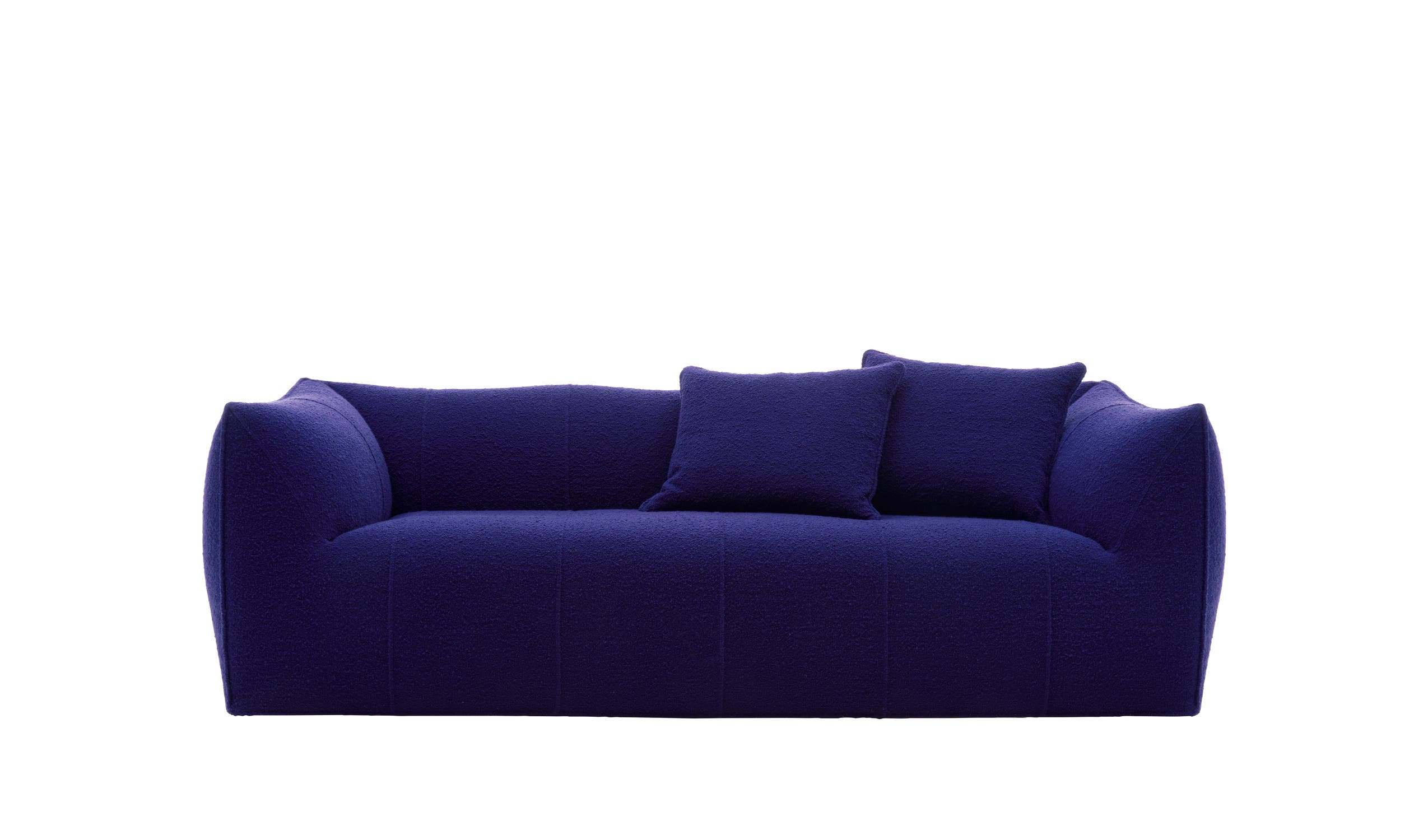
The LE BAMBOLE armchair, designed by Mario Bellini for C&B Italia (the company’s name prior to 1973) in 1972, won the Compasso d’Oro in 1979 and holds a place in the permanent design collection of the Museum of Modern Art in New York, where the armchair is catalogued with dimensions of 72 x 120 x 90.2 cm (28 3/8 x 47 1/4 x 35 1/2 inches) in differential-density polyurethane foam, Dacron, and fabric. LE BAMBOLE was the first upholstered furniture design to appear in a fashion-context advertising campaign: photographer Oliviero Toscani shot model Donna Jordan (a muse of Andy Warhol and the New York creative scene) in a topless editorial on the armchair and loveseat, presented at the 1972 Salone del Mobile in Milan, where the images were censored with black bars before later running in publications and exhibitions.
Mario Bellini’s stated design principle for LE BAMBOLE was that the seating should be “not upholstered with fabric, but built in fabric.” The original construction embedded a metal skeleton within multiple densities of polyurethane foam, with the outer fabric functioning not as a decorative cover but as a structural membrane that absorbed and distributed tension across the cushion surfaces. LE BAMBOLE was the fifth product Mario Bellini designed for C&B Italia, following the 4 Gatti, Amanta, Gli Scacchi, and Camaleonda collections. Bellini has received eight Compasso d’Oro awards across his career and has approximately 25 works in MoMA’s permanent collection. B&B Italia released a 50th-anniversary re-edition of LE BAMBOLE in 2022, replacing the original metal frame with recycled polyethylene and eliminating adhesives from the construction, allowing complete disassembly for recycling. The 2022 LE BAMBOLE collection includes the Bambola armchair, the Bibambola two-seater sofa, and the new Granbambola three-seater sofa, with current retail prices for the LE BAMBOLE series starting at approximately EUR 6,500 depending on configuration and upholstery selection.
What Makes the CHARLES Sofa by Antonio Citterio a Secondary Market Benchmark Since 1997?
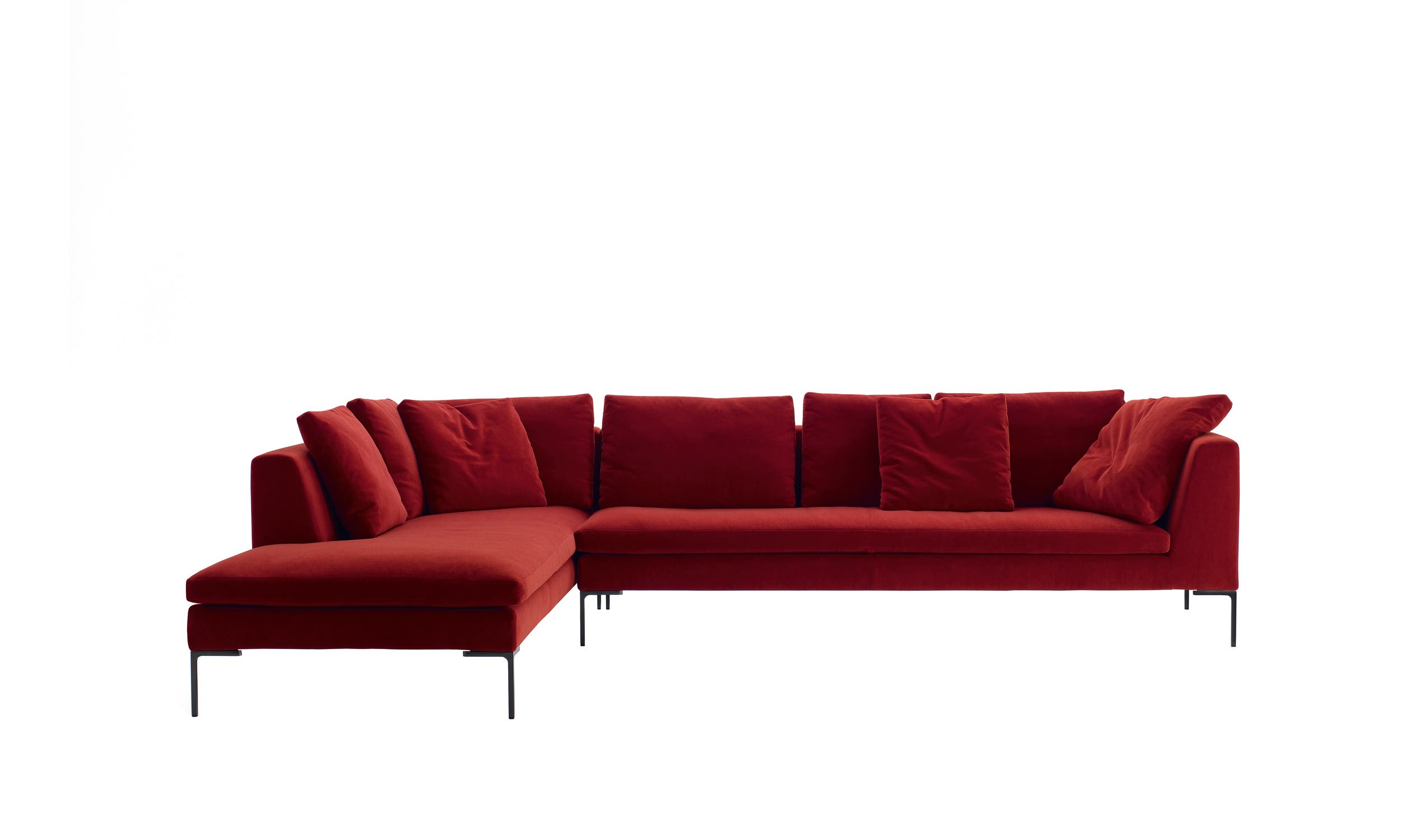
The CHARLES sofa, designed by Antonio Citterio in 1997 and in continuous production since that year, uses an internal frame of tubular steel and steel profiles upholstered with Bayfit flexible cold-shaped polyurethane foam and polyester fibre cover, with seat cushions combining shaped polyurethane of different densities and sterilized down under a polyester fibre cover. The CHARLES sofa’s signature detail is the die-cast aluminium foot in the shape of an inverted “L,” which raises the sofa body 19 cm (7 1/2 inches) from the ground and gives the piece its characteristic visual lightness. Standard CHARLES module dimensions measure 230 cm wide x 97 cm deep x 73 cm high, with a seat height of 42 cm. Antonio Citterio named the CHARLES sofa as a tribute to Charles Eames, referencing the American designer’s principle that “the details are not the details; they make the design.”
The CHARLES sofa’s multi-density foam calibration and stainless aluminium base system have remained structurally unchanged since 1997, making the CHARLES the longest-running and best-selling sofa in the B&B Italia catalogue. The CHARLES modular system allows in-line two- or three-seater configurations, chaise longue compositions, corner sofas, and peninsula arrangements. CHARLES sectional configurations in the B&B Italia Official Shop start at approximately USD 20,356 for a left sectional in fabric upholstery. On the secondary market, authenticated CHARLES sofas from the early 2000s regularly appear on platforms such as 1stDibs and specialized design resellers, where provenance and original upholstery condition are the primary factors determining resale value. The consistency of the CHARLES construction specification across 28+ years of production means that replacement covers and cushion components remain available through B&B Italia’s authorized dealer network, a practical advantage that distinguishes long-production pieces from discontinued designs. Antonio Citterio, born in Meda (Milan) in 1950, received the Compasso d’Oro in 1987 and 1994 and holds the title of Royal Designer for Industry from the Royal Society for the Encouragement of Arts, Manufactures and Commerce of London, awarded in 2008.
How Does the TUFTY-TIME by Patricia Urquiola Prove B&B Italia’s Stylistic Range?
The TUFTY-TIME sofa system, designed by Patricia Urquiola and introduced in 2005, is a modular seating system that reinterprets the traditional Chesterfield and capitonne sofa typologies through an informal, free-composition structure. The TUFTY-TIME internal frame uses tubular steel and steel profiles with Bayfit (Bayer) flexible cold-shaped polyurethane foam, and the upholstery surface is divided into large quilted squares joined by tufted pleats (perforated in the leather version). The TUFTY-TIME modular system begins with an ottoman as the basic unit, expandable with central elements, corner elements, and terminal elements with either low or high armrests, allowing configurations that include linear sofas, chaise longue sofas, corner arrangements, and 360-degree island seating compositions.
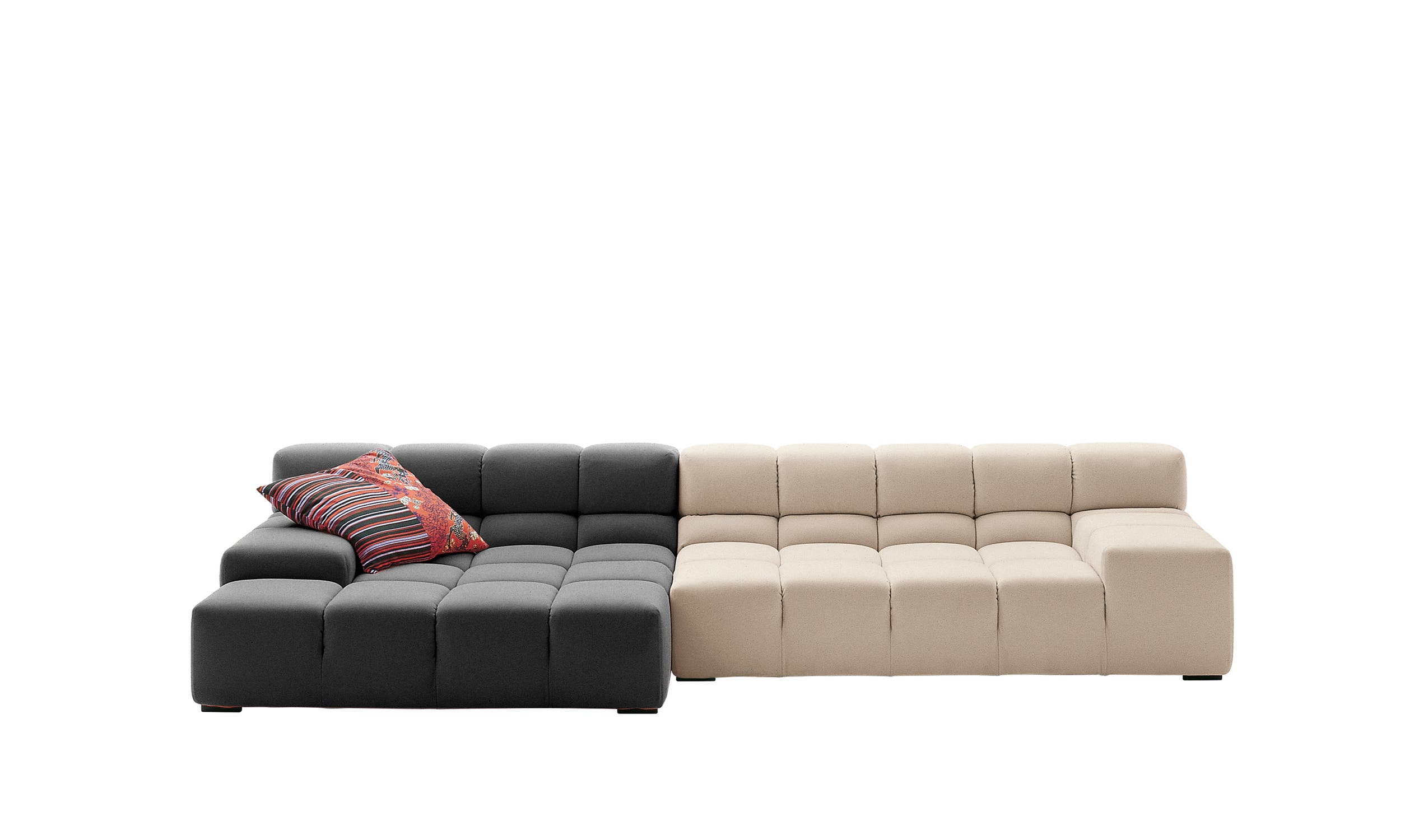
Patricia Urquiola studied architecture at the Universidad Politecnica de Madrid and completed her degree at the Politecnico di Milano under the mentorship of Achille Castiglioni. Urquiola described the TUFTY-TIME concept in 2005: “I wanted to revisit capitonne and Chesterfield types of sofas, while paying special attention to the new interpretations made in the 1960s and ’70s, which I have great regard for.” The TUFTY-TIME system remains one of B&B Italia’s most commercially successful series 20+ years after introduction, available in the B&B Italia Official Shop starting at approximately USD 13,628 for a basic configuration. The TUFTY-TIME’s position within the B&B Italia catalogue matters because the design represents the opposite end of the formal spectrum from the CHARLES sofa: where CHARLES distills mid-century precision and structural clarity, TUFTY-TIME absorbs and reprocesses decorative tradition through a contemporary filter. Both designs have remained in continuous production for over two decades, and both were produced under the same company’s research and development infrastructure, demonstrating B&B Italia’s capacity to sustain parallel and stylistically opposed design arguments simultaneously.
What Does the UP Series by Gaetano Pesce Reveal About B&B Italia’s Relationship Between Design and Art?
The UP series, designed by Gaetano Pesce in 1969, consists of seven seating pieces made entirely from polyurethane foam and upholstered in elastic jersey fabric, originally produced for C&B Italia. The most recognized piece in the UP series, the UP5_6 armchair and ottoman, measures approximately 100 cm wide x 120 cm deep x 103 cm high and uses anthropomorphic, fertility-goddess-inspired forms that Pesce described as a deliberate political statement about women’s condition. Gaetano Pesce explained: “At that time, I was seeking to tell a personal story about my concept of women: I believe that women have always unwittingly been their own jailer. This is why I decided to give this armchair the shape of a woman with a ball and chain, reflecting the traditional image of a prisoner.” The spherical UP6 ottoman, connected to the UP5 armchair by an elastic cord, serves as the visual and symbolic representation of this restraint.

The original 1969 UP series used Freon gas to vacuum-compress each piece to one-tenth of its volume for flat-pack shipping; the buyer would open the packaging, and the furniture would expand to its final form. B&B Italia discontinued the UP series in 1973 when Freon gas was banned because of ozone-layer damage. B&B Italia re-issued the UP series in 2000 as the Serie UP 2000, replacing the original self-expanding construction with cold-shaped polyurethane foam produced in its final shape without vacuum compression. The Serie UP 2000 won the XXVII Compasso d’Oro ADI Product Career Award in 2022, recognizing the design’s 53-year cultural and industrial significance. Current Serie UP 2000 pieces are produced in B&B Italia’s Novedrate factory using the same cold-foaming technology applied across the company’s upholstered furniture range. The UP5_6 armchair and ottoman are available in the B&B Italia Official Shop at approximately USD 8,337 in elastic fabric. The UP series’ position in the B&B Italia catalogue demonstrates the company’s willingness to hold design positions that operate closer to sculpture and political commentary than to conventional residential furniture, a range of intent that few competitors can claim across six decades of continuous operation.
Why Is the MAXALTO FEBO Armchair B&B Italia’s Clearest Statement on Modernism and Tradition?
The MAXALTO FEBO armchair, designed by Antonio Citterio for the Maxalto division of B&B Italia, is constructed with a steel internal structure and cold-foamed polyurethane padding, available in three configurations: armchair with low backrest (66.5 cm wide x 66 cm deep x 66 cm high), armchair with high backrest (73 cm wide x 73 cm deep x 79 cm high), and bergere. The FEBO collection extends beyond armchairs to include sofas, chaise longues, beds, dining chairs, and ottomans, forming a complete residential system. A distinguishing construction detail of the FEBO collection is the “blanket stitch” edging, executed by hand and customizable in thread colour, a sartorial reference that positions the FEBO closer to tailoring tradition than to industrial production vocabulary.
Maxalto was founded in 1975 alongside B&B Italia, with architects Afra and Tobia Scarpa as its first design interpreters. The name Maxalto derives from the Venetian dialect phrase “massa alto,” meaning “the highest,” referencing the division’s commitment to the highest standards in materials and artisanal workmanship. Maxalto’s production facility in Misinto covers over 10,500 square metres and is situated within the Groane Park nature reserve, where environmental compliance checks are regularly performed. Since 1993, Antonio Citterio has served as Maxalto’s sole designer and art director, developing what Citterio describes as “modern neo-classics,” pieces filtered through contemporary Italian architectural sensibility but rooted in the typologies and material traditions of French design between the two World Wars, particularly the work of Jean-Michel Frank.

The FEBO’s significance within the B&B Italia group is structural, not merely aesthetic. Maxalto functions as the classical counterpoint to B&B Italia’s modernist and experimental main line: while B&B Italia produces designs by Pesce, Urquiola, Zaha Hadid, and Naoto Fukasawa, Maxalto concentrates a single designer’s sustained vision of what contemporary classicism can mean when executed at the highest material standard. The FEBO armchair, starting at approximately EUR 2,605 in fabric, represents the entry point to this parallel conversation. B&B Italia is a founding member of the Altagamma Foundation, the association of Italian luxury brands, a distinction that reflects the company’s position at the intersection of industrial design and the broader Italian luxury goods sector. Owning a FEBO armchair means holding a piece that belongs simultaneously to B&B Italia’s 60-year manufacturing tradition and to a specific argument about the compatibility of modernism and decorative warmth that Antonio Citterio has been developing through Maxalto for more than 30 years.
What Does Owning a B&B Italia Piece That Has Been in Production for 20+ Years Actually Mean?
A B&B Italia product that has remained in continuous production for 20 or more years carries specific practical and cultural consequences that distinguish the piece from discontinued designs. The CHARLES sofa (in production since 1997, 28+ years), the TUFTY-TIME (since 2005, 20+ years), the LE BAMBOLE (originally 1972, re-editioned 2007 and 2022), and the UP series (1969, re-issued 2000) all benefit from ongoing manufacturer support including replacement covers, cushion refills, spare components, and authorized dealer servicing. Discontinued designs on the secondary market carry no such manufacturer support guarantee.
The resale market behaviour of long-production B&B Italia pieces follows a different pattern from discontinued collectibles. Pieces like the CHARLES sofa depreciate initially (as all used furniture does) but stabilize at a floor value supported by the design’s continued cultural visibility and the availability of factory-authorized restoration options. Vintage 1969 UP series pieces command premium prices on 1stDibs and specialist dealers because the original Freon-expanded construction differs materially from the 2000 re-edition. The following table summarizes the key production and market data for the five B&B Italia pieces examined above:
| Product | Designer | Year Introduced | Years in Production | Key Material Innovation | Approximate Starting Price (New) |
|---|---|---|---|---|---|
| LE BAMBOLE armchair | Mario Bellini | 1972 | 50+ (re-editioned 2022) | Multi-density polyurethane with fabric-as-structure | EUR 6,500 |
| CHARLES sofa (230 cm) | Antonio Citterio | 1997 | 28+ | Bayfit cold-shaped foam, die-cast aluminium L-feet | USD 20,356 (sectional) |
| TUFTY-TIME sofa | Patricia Urquiola | 2005 | 20+ | Quilted tufted modular system with removable covers | USD 13,628 |
| UP5_6 armchair + ottoman | Gaetano Pesce | 1969 (re-issued 2000) | 56+ (design); 25+ (current production) | Cold-shaped polyurethane foam, elastic jersey upholstery | USD 8,337 |
| MAXALTO FEBO armchair | Antonio Citterio | Ongoing (Maxalto collection) | Part of ongoing Maxalto line since 1993 redesign | Steel frame, cold-foamed polyurethane, hand blanket stitch | EUR 2,605 |
The knowledge required to situate each B&B Italia piece in the company’s 60-year design conversation goes beyond identifying a model name and designer. Understanding the CHARLES sofa means understanding why Antonio Citterio has served as Maxalto’s art director since 1993 while simultaneously designing for the B&B Italia main line, and what the difference between those two roles reveals about the company’s internal design logic. Understanding the UP series means understanding why B&B Italia re-issued a 1969 design in 2000 rather than commissioning a replacement, and what the shift from Freon-expanded to cold-shaped polyurethane means for the physical character of the object. Understanding LE BAMBOLE means understanding the relationship between Mario Bellini’s fabric-as-structure concept, the Oliviero Toscani advertising campaign that made the armchair a cultural object beyond its function, and the 2022 decision to rebuild the same form using recycled polyethylene and adhesive-free construction. These layers of context are what separate a showroom capable of selling B&B Italia from a showroom capable of placing B&B Italia in a room with the authority the brand’s history requires.
Frequently Asked Questions About B&B Italia’s Design History and Collection
When was B&B Italia founded, and where is the company headquartered?
B&B Italia was founded in 1966 by Piero Ambrogio Busnelli in Novedrate, province of Como, Italy, initially as C&B Italia in partnership with Cesare Cassina. B&B Italia adopted its current name in 1973 when Busnelli took full ownership. The company’s Novedrate headquarters, designed by Renzo Piano and Richard Rogers in 1971, cover over 27,000 square metres and house all production facilities for upholstered furniture, the company’s Research and Development Centre, and a 1,300-square-metre showroom. B&B Italia has been part of Design Holding (alongside Flos and Louis Poulsen) since December 2018, with approximately 600 employees and 750 points of sale worldwide.
What is the Maxalto division, and how does Maxalto differ from B&B Italia’s main collection?
Maxalto was established in 1975 as B&B Italia’s classical furniture division, initially designed by architects Afra and Tobia Scarpa. Since 1993, architect Antonio Citterio has served as Maxalto’s sole designer and art director. Maxalto products are manufactured at a dedicated 10,500-square-metre facility in Misinto, Italy, specializing in high-quality wood processing and artisanal finishing. Maxalto’s design language draws from French design traditions between the two World Wars, producing what Citterio describes as “modern neo-classics,” while the B&B Italia main line focuses on contemporary and experimental design by multiple international designers.
Which B&B Italia products are in the MoMA permanent collection?
Mario Bellini’s LE BAMBOLE armchair (1972) is in the permanent design collection of the Museum of Modern Art (MoMA) in New York, catalogued as a gift of the manufacturer with dimensions of 72 x 120 x 90.2 cm in differential-density polyurethane foam, Dacron, and fabric. Mario Bellini has approximately 25 works in MoMA’s permanent collection across his career. Gaetano Pesce’s UP5 armchair from the UP series is also held in major design museum collections worldwide. B&B Italia has won four Compasso d’Oro awards (1979, 1984, 1987) and the UP series received the Compasso d’Oro Product Career Award in 2022.
Is the B&B Italia CHARLES sofa still in production, and has the design changed since 1997?
The B&B Italia CHARLES sofa, designed by Antonio Citterio in 1997, remains in continuous production as of 2026. The CHARLES sofa’s core construction specification (tubular steel and steel profile internal frame, Bayfit flexible cold-shaped polyurethane foam, die-cast aluminium inverted-L feet at 19 cm height, seat height of 42 cm) has remained structurally unchanged since the original 1997 production. B&B Italia introduced the CHARLES Large variant in 2003, expanding the modular system’s configuration options. The CHARLES sofa is widely recognized as B&B Italia’s longest-running and best-selling sofa design.
What happened to the original B&B Italia UP series, and how does the Serie UP 2000 differ?
The original UP series, designed by Gaetano Pesce in 1969 for C&B Italia, used Freon gas to vacuum-compress each polyurethane piece to one-tenth of its volume for flat-pack shipping; the furniture expanded to full form when unpacked. B&B Italia discontinued the original UP series in 1973 after Freon gas was banned for its ozone-depleting properties. B&B Italia re-issued the complete seven-piece UP series in 2000 as the Serie UP 2000, using cold-shaped polyurethane foam produced in its final shape without vacuum compression. The 2000 re-edition maintains the original forms and dimensions but uses a different foam technology, making original 1969 Freon-expanded UP pieces distinct collector’s items separate from current production.