
Ergonomic Adaptation of European Furniture for Middle Eastern Markets
Updated:
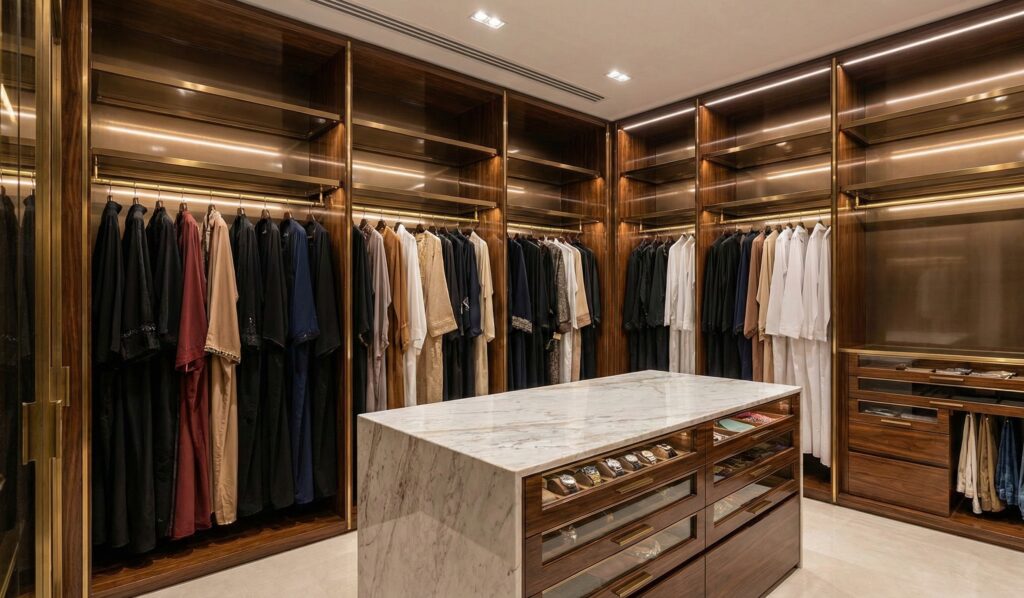
Successfully integrating continental aesthetics into Gulf Cooperation Council (GCC) residential projects requires more than visual alignment; it demands rigorous structural and ergonomic recalibration. While European furniture sets the global standard for craftsmanship, standard dimensions often fail to align with the anthropometric and social requirements of the Middle East. For instance, a cohesive luxury interior requires that a bespoke Italian walk-in closet design not only matches the visual language of the master suite but also accommodates the specific storage density and reach ranges typical of the region. Leading manufacturers like Modenese Bespoke mitigate this by adjusting base frameworks before export, ensuring that Italian design integrity remains intact during the transition to Saudi or Emirati living environments.
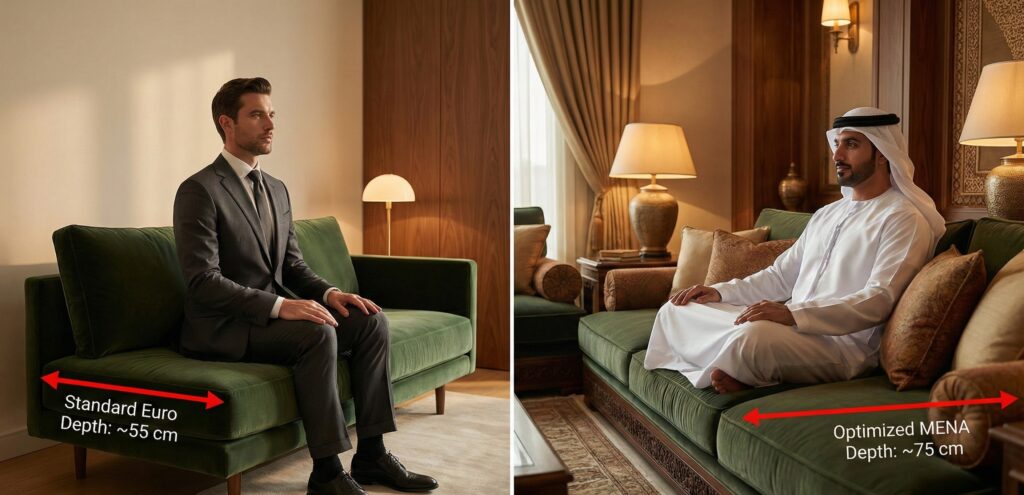
Anthropometric Variances: Seat Depth and Height Analysis
The primary friction point in importing European furniture to the MENA (Middle East and North Africa) region is the disparity in sitting habits. European ergonomics (defined by standards such as ISO 7250-1:2017) assume a “perched” posture with feet flat on the floor. Conversely, Middle Eastern social customs, particularly in Majlis settings, involve prolonged sitting durations and varying postures, including cross-legged sitting (Agra’a), which alters the center of gravity and requires a support surface.
Standard European seat depths (typically 50-55 cm) are insufficient for maintaining cross-legged postures, which can lead to user fatigue. For the GCC market, furniture specifications must shift to deeper pans and lower heights to accommodate these biomechanics.
Comparative Specification Table: Euro vs. MENA Standards
| Measurement Parameter | Standard European Spec | Optimized MENA Spec | Ergonomic Rationale |
|---|---|---|---|
| Seat Height (Anterior) | 45 cm – 48 cm | 40 cm – 43 cm | Facilitates easier transition from standing to low-seated or floor-level social interactions. |
| Seat Depth (Effective) | 52 cm – 56 cm | 65 cm – 75 cm | Provides necessary surface area for cross-legged postures without thigh overhang. |
| Backrest Angle | 100° – 105° | 110° – 115° | Supports a more relaxed, reclining trunk position typical of extended Majlis gatherings. |
| Armrest Height | 60 cm – 65 cm | 55 cm – 60 cm | Lowered to prevent shoulder elevation when using side cushions (Tarka) for support. |
Upholstery Mechanics: Density and Thermal Load
Climate control in GCC interiors presents specific challenges for soft furnishings. While ambient air temperatures are regulated by HVAC systems, contact heat accumulation remains a critical failure point for standard European upholstery. High-friction synthetics or heavy wools used in Northern Europe create thermal discomfort in arid climates.
Foam Density and ILD Ratings
In Majlis environments, where seating sessions often exceed 3-4 hours, standard low-density polyurethanes (30-35 kg/m³) suffer from rapid compression set (sagging). Modenese Bespoke utilizes High Resilience (HR) cold-cure foams with densities exceeding 50 kg/m³ to counteract this. The Indentation Load Deflection (ILD) must be calibrated to support higher static loads distributed over larger surface areas.
Textile Permeability
Fabric selection determines the furniture’s thermodynamic performance. For optimal heat dissipation, natural fiber blends with high air permeability ratings are required. When sourcing italian fabrics for this region, specifiers should prioritize textiles with Martindale abrasion ratings above 40,000 cycles and high moisture regain properties (such as viscose or cotton-linen blends) to prevent humidity entrapment against the skin.
Circulation Dynamics in Social Layouts
European living room layouts typically organize convergent seating around a central focal point, such as a television or fireplace. Middle Eastern Majlis layouts instead use a divergent, peripheral arrangement to maximize sightlines for all guests. The Majlis configuration therefore requires corresponding adjustments to furniture scale and module connectivity. The B&B Italia design philosophy provides related context on the evolution of European furniture design.
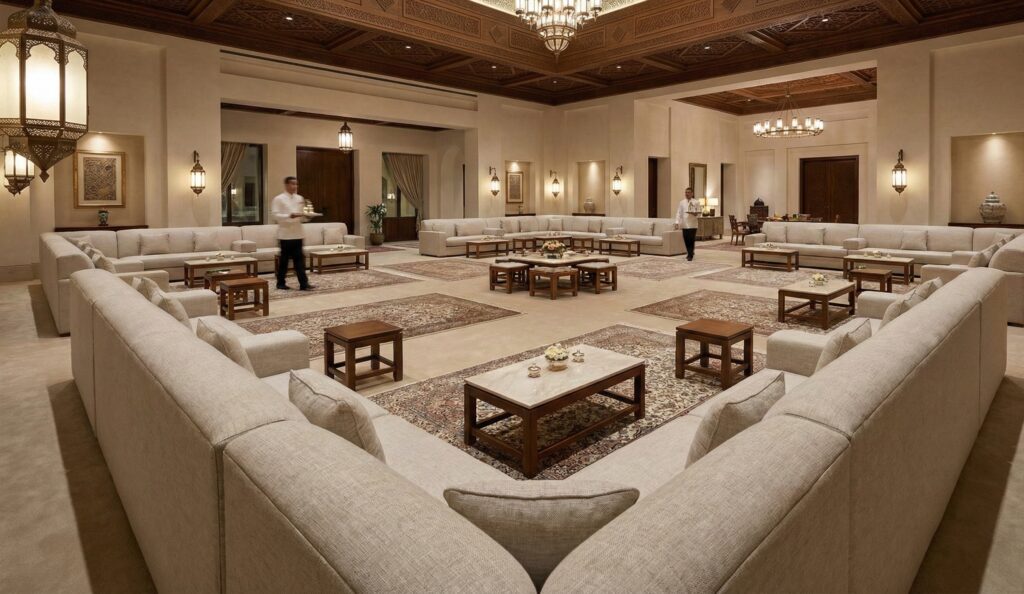
- Peripheral Anchoring: Sofas must be finished fully on the back, as they often stand off-wall to allow for service circulation behind the seating line.
- Corner Modules: Standard 90-degree corner units are often “dead space” in European layouts. In MENA adaptations, corner units must be radiused or expanded to function as active seating zones.
- Circulation Widths: Service paths for hospitality (coffee/tea service) require wider clearance zones. ADA guidelines suggest 36 inches, but luxury Majlis standards recommend a minimum of 1.2 meters (47 inches) between the central table cluster and peripheral seating to accommodate service staff.
Structural Reinforcement for Dynamic Loads
The structural carcass of the furniture requires reinforcement to handle the increased leverage forces exerted by deeper seat pans and reclining postures. Standard beechwood frames used in Italy may experience torsion failure under these specific stresses if not modified.
Required Structural Modifications:
- Central Support Rails: Spans exceeding 1.8 meters must include a third, central leg or steel-reinforced rail to prevent bowing.
- Webbing Tension: Elastic webbing grids typically spaced at 50mm in Europe should be reduced to 20-30mm spacing to increase suspension rigidity.
- Joinery: Double-dowel or mortise-and-tenon joints are mandatory; staples or basic screws are insufficient for the dynamic shifting loads of active social seating.
Data from the American National Standards Institute (ANSI/BIFMA X5.4) regarding lounge seating tests suggests that static load capacities should be increased by 25% for high-use public or semi-public reception areas, a standard that aligns well with private Majlis requirements.